Friday, November 14, 2014


HNS Indie Awards 2016


HNS Indie Awards 2015


HNS Indie Awards 2014


Saturday, August 02, 2014

Review: The Tin Snail by Cameron McAllister


'The Tin Snail' by Cameron McAllister is a charming, somewhat old-fashioned read that delights with its humour, adventure, patriotism and love. Invoking the spirit of war-time France, it tells the tale of the development of the French version of the ‘people’s car’, the Citroën 2CV. We have baddies ranging from Nazis, including the villainous Ferdinand Porche, designer of the VW Beetle and the Panzer tank, who is trying to steal the plucky French design for Germany, to young Philippe, the jealous love rival, and his father, Victor, the pompous and obstructive mayor, who are ultimately redeemed by their courage and patriotism.

'The Tin Snail' is well plotted and the story unfolds like a script for a rattling good family film. However, although the book is illustrated, it is never completely clear from pictures or text what the revolutionary designs look like, unless one is already familiar with the 2CV (which my daughter was not). I wonder whether as a screenwriter, the author was imagining that all would become apparent on screen?
It appears to be creative non-fiction, telling the true story of the development of the car, so I felt a little cheated that that having invested in Angelo, his father Luca Fabrizzi, Christian Silvestre and Bertrand Hipaux, I discovered that their names were really Flaminio Bertoni, André Lefèbvre and Pierre Jules Boulanger. I don’t even know whether Fabrizzi’s son Leonardo had anything at all to do with the design. The other niggle is the sub-title: The little car that won a war – it didn’t. What actually happened was that the prototypes were deliberately hidden from the Germans and the car only went into production in 1948.
That said, this is a delightful book for anyone over the age of eight, and it would make a tremendous film.

This review first appeared in Historical Novels Review Issue 69 (August 2014). Book supplied by publisher.

Tuesday, July 29, 2014

Medieval graffiti in England's churches


The 'straw king', a medieval graffiti drawing that could be a pagan fertility symbol. Photo: Lincolnshire Medieval Graffiti Project.

The BBC reports a four-year-oldLincolnshire medieval graffiti project which has uncovered more than 28,000 examples of centuries-old carvings etched by bored medieval church-goers, some of which appear to depict pagan symbols and imagery. But do these graffiti drawings really reveal a lingering devotion to paganism?

On the walls near the entrance to Cranwell Parish Church, in Lincolnshire,  is a figure identified as "the straw man". Brian Porter, Lincolnshire's medieval graffiti project co-ordinator, believes the figure to be a pagan fertility symbol, possibly etched before a May Day celebration.

The BBC goes on to state that 'in pre-Christian tradition the "straw man" was made out of the previous year's crop and then eventually burned, with the ashes scattered across the fields. Mr Porter said he believed the church "couldn't stamp out" the Pagan traditions of parishioners and probably grew tired of rubbing the graffiti away. It raises a tantalising prospect. Could it be that beneath the Christian veneer, an older tradition was still being actively pursued, perhaps in a deliberately subversive way?'

Professor Ronald Hutton confirms in his book Stations of the Sun that the making of corn symbols from straw was done as part of a harvest ritual.  The last sheaf in the field to be harvested was often given a name, such as the maiden, the old woman, the mare or the neck.  Hutton specifically mentions a figure from 1598 at Windsor that is woven from straw and dressed as a woman.  There are accounts through to the 1800’s (Hutton 2001:332-347). All such folk customs are indeed fascinating and may plausibly be considered as remnants of pre-Christian practice and belief.

But why does Mr Porter conclude that this church graffiti figure is a representation of a corn dolly? Surely it is clearly identifiable as a man in rich Tudor dress? Oh I do wish Mr Porter were correct, but to my eyes there is nothing to suggest anything of the corn or harvest in the image. I suspect this is wishful thinking on Mr Porter's part, a suspicion perhaps shared by Matt Champion, the medieval archaeologist who began the project in Norfolk in 2010, who says there are a variety of different theories and care is needed when interpreting the drawings.

"Brian could be right," he says. "But we have different perspectives. To be honest, I've yet to come across a genuine pagan symbol. Not all [Christians at the time] were closet pagans."


Yeah. Dream on Brian!

Monday, June 30, 2014

Review: Buffalo Soldier by Tanya Landman


Buffalo Soldier explores of the nature of freedom, in a searingly poignant story told from the perspective of Charlotte, a young African-American slave from the deep south of America at the end of the Civil War. After witnessing the rape and lynching of her adoptive mother, Charlotte is pitched all alone into a world of war and terror. Officially emancipated from slavery, she is still trapped by the colour of her skin but also by her gender. Now that even her value as a slave has been stripped from her, in desperation she dons a dead man’s clothes and joins the US Army, becoming ‘Charley’, a ‘buffalo soldier’. Her journey takes her from coast to coast cutting a swathe through a unpleasant period of US history, during which we see Buffalo Bill initiating the sanitisation of the record.

This is an extraordinarily powerful book, immaculately written in a sustained voice that never misses a beat. The analogies and observations that flesh out the narrative are superbly observed and always completely in character and period. We are literally observing the world according to Charley, and her take on it is skilfully developed throughout her journey. Landman doesn’t shy away from the sights, sounds and language that characterized slavery and its aftermath, but the further that Charley moves away from the former Confederate slave states, the more she adopts the different spoken styles indicating the prejudices of the soldiers around her, in a changed world order in which the Native Americans are at the bottom of the heap. Yet she is finally shown the meaning of true freedom by an Apache with whom she is able to discover a viable identity for herself as a woman.

Important material is sensitively addressed, making this a must-read book for all over-twelves.

Review first appeared in Historical Novels Review Issue 68 (May 2014)


Saturday, May 17, 2014

Reverse Ferret

Reverse Ferret

UKIP Leader Nigel Farage got a right savaging for 20 minutes by James O'Brien on LBC yesterday, until his spin doctor intervened to get him off air. I wouldn't normally have heard this clip, (as I don't enjoy O'Brien's interview technique - I find him hectoring and too fond of his own voice and I don't care much for Farage's opinions on anything), but for the fact that O'Brien accuses Farage of "reverse feretting" over a promise to have his expenses independently audited – an offer Ukip made but Farage withdrew saying he would not be subject to a stricter audit than other MEPs. The phrase appeared in headlines on social media. It's at 18 min 30 sec in this video.


Hello! I thought, what on earth is "reverse feretting" when it's at home? I had to Google it!

It turns out to be media luvvy-speak for a volte-face on the editorial line on a certain issue. It's sufficiently specialised for the Guardian to feel the need to define it in this article from 2011:
"Reverse ferret" is, technically speaking, a term used in Fleet Street, just down the road, to describe the moment when an editor executes a startling editorial U-turn.
It even has its own Wikipedia entry:
Reverse ferret is a phrase used predominantly within the British media to describe a sudden reversal in an organisation's editorial line on a certain issue. Generally, this will involve no acknowledgement of the previous position.
The term originates from Kelvin MacKenzie's time at The Sun. His preferred description of the role of journalists when it came to public figures was to "stick a ferret up their trousers". This meant making their lives uncomfortable, and was based on the supposed northern stunt of ferret legging (where contestants compete to show who can endure a live ferret within their sealed trousers the longest). However, when it became clear that the tide of public opinion had turned against the paper's line, MacKenzie would burst from his office shouting "Reverse Ferret!" 
Now I know that background, I find it really rather colourful and I quite like it. Oddly though, Farage appeared to be quite familiar with the term which was somewhat surprising given his words at the start of the interview,
"This is the political class clubbing together using their mates in the media and doing anything they can to stop the UKIP charge." 
This is an irony that seems to have completely bypassed the testy Mr O'Brien in his nasty little media-luvvy bubble. How ironic!
Saturday, April 26, 2014

UKIP v. the Establishment

As someone who believes that the current tripartite party system is incestuous, corrosive and corrupt, I find it very interesting in the run up to the 2014 European elections, that UKIP (whose xenophobic position is not mine, by the way) appears to be getting under the skin of the powers that be. Instead of being treated as genial buffoons on the fringes of politics, the mainstream media (in all its forms) is having a right ad hominem go at UKIP leader Nigel Farage.

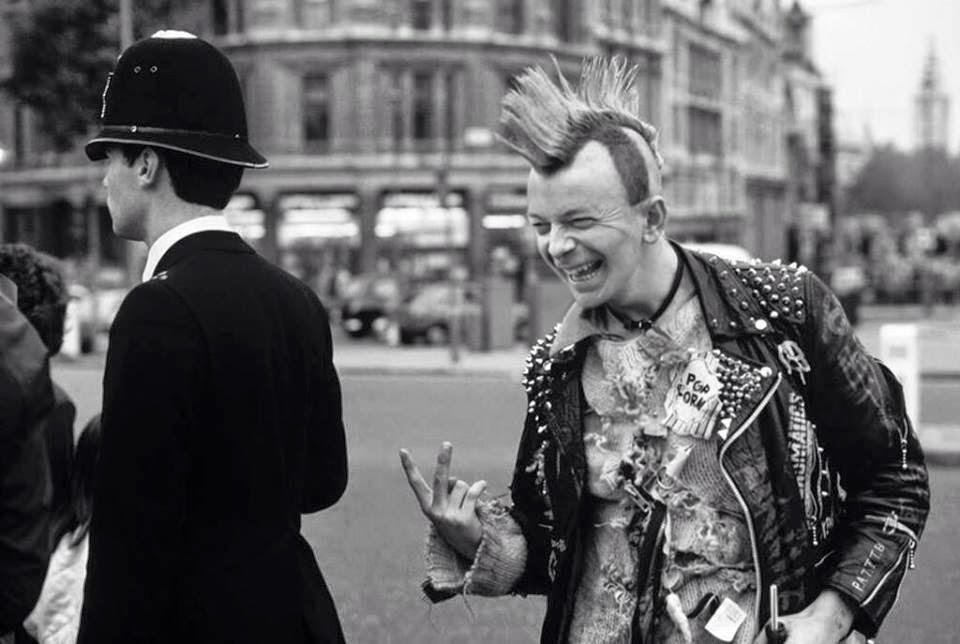
A recent social media manifestation rather tickles me though. This image is being gleefully shared on Facebook:

Nigel Farage, leader of UKIP circa 1983... UKIP wanted it banned, so here it is!

I have pointed out to those of my friends who shared it that it is in fact nicely done Photoshop work  - Farage's face has been applied to this image:


(However, if Farage had actually ever been a punk, I doubt that he'd have had a 50 year old face at the time...)

Anyway, I'm quite intrigued about who did the tidy Photoshop job and why. Given that punk was a uniquely British phenomenon characterised by a two-fingers-protest against the existing regime, wrapped in tartan and the Union Jack, what could this "fake" rebel image do for Farage? Certainly no harm at all!

So is it a clever viral campaign by UKIP or a memorable own goal by Conservative Central Office? Or just a random person messing about.

Answers on a ballot card!


Even Johnny Rotten is a mainstream Brit icon now:

Wednesday, March 19, 2014

Learning our lines


According to the Daily Mail, a study by the Organisation for Economic Co-operation and Development says that "the number of families saying they are going hungry has fallen over the past five years – as the number of food banks has risen."

This is obviously because more people are being fed, so fewer are going hungry, right? But such deductions are not the Daily Mail way. Their take is based on Lord Freud's, (the UK Welfare Minister), statement that "it is very hard to know why people go to food banks". They report, "while he conceded nobody turned to charities for food parcels ‘willingly’, more people were visiting the banks simply because there were more in existence." Personally I find that to be an argument worthy of Comical Ali, Saddam's Information Minister, who said "there is no presence of American infidels in the city of Baghdad," as the world's media recorded the line of tanks rolling across the bridge in shot behind him. And while Freud says (to all intents and purposes) "let them eat cake", that is not really the nature of this post and it's not that kind of line.

The foodbank situation has led to a considerable amount of commentary about people in the UK being "below the breadline" and getting lines crossed is the nature of this post. People can be 'near the breadline' and they can be 'on the breadline' but they cannot be 'below the breadline'.


The term breadline is borrowed from the Americans who use 'line' where we would use the word 'queue'. So a breadline is a queue for bread. It is not some arbitrary measure of relative poverty, some economic Plimsoll line below which one must not be sunk. The breadline is a physical queue for food handouts - the literal end of the line is the foodbank.

It is an absolute disgrace that some commentators (who should know better) should use the term 'breadline', frivolously and relatively to score political points without seeing it for what it is, when it is an absolute that many Britons are on, or near, or approaching.

There is no 'below the breadline'. When you can't afford food there is no going 'below' that.

Friday, March 07, 2014

Seminar on Herbal illustration and identification at Kew -18 June 2014

British Library MS Harley 3736/10r. Charlemagne and the plant Carlina
This is a heads up for any of my herby friends (or arty or historically minded ones) who might like to attend.


Illustration and Identification in the History of Herbal Medicine

18 June 2014


Organized by Anne Stobart (Herbal History Research Network) and  Frances Watkins (University of East London, UK)
Jodrell Lecture Theatre
Royal Botanic Gardens, Kew
Richmond TW9 3DS
United Kingdom
The aim of this day seminar on Wednesday 18th June 2014 is to bring together researchers to explore issues related to plant illustration and identification in the history of herbal medicine. Correct identification of plants in the past has been of great importance, whether for foods, medicines or other purposes. But to what extent did people in medieval and early modern times learn about plants with medicinal uses from illustrations in herbals or elsewhere? Matters of interest include ways in which illustrations were produced, the role of illustrations, dissemination of information about plant identification, significant observers of plants and their approaches to plant description. This day seminar at Kew Botanic Gardens near London, UK, has been organised with a particular focus on presenting research into finding and interpreting archival and other sources relating to the history of herbal medicine.
Main speakers:
Julia Boffey, Queen Mary and Westfield College, University of London
Isabelle Charmantier, University of Exeter
Maria Daronco, University of Udine, Italy
This event is organised by the Herbal History Research Network group which aims to promote research into the history of herbal medicine. The Network helps to connect together people who share common interests in researching the history of herbal medicine through seminars and other events. For further details of the Network contact Anne Stobart at a.stobart@herbaid.co.uk
Please see the supporting material for the day seminar programme and registration form at: http://events.history.ac.uk/event/show/12436?ref=email

Saturday, February 01, 2014

Knight Crusader

It's about time I caught up on this blog and published some of the recent book reviews I've done for the Historical Novels Review Children's and Young Adult list.

This one is for a re-issue of a classic, Knight Crusader.

Ronald Welch won the Carnegie prize in 1954 for Knight Crusader, an action packed tale of a young Norman nobleman from Outremer, Philip d’Aubigny.

The new edition retains the evocative original illustrations and cover art by William Stobbs. Unusually it also includes a Note on the Text for modern readers, rather euphemistically referring to ‘difficult’ language of a classic re-published in its original form. However, it is not that the vocabulary is incomprehensible to a strong reader of 8 to 12. It is rather that political correctness dictates that pejorative expressions like ‘half-breed’ are no longer used in new works for young people. However, Welch shows the newly arrived Norman barons as ugly, racist, barbarian thugs, whereas the protagonist, Philip, is a third generation ‘Syrian’ lord, who has assimilated elegant customs and practices of the East and is sophisticated and enlightened in comparison. Philip is a pretty darn heroic hero, yet even he holds some unsavoury opinions of the ‘Pullani’, or mixed race noblemen, as untrustworthy schemers.

The plot claps along at a splendidly brisk pace, informed by the author’s superb knowledge of place and period. The fight and battle scenes in particular are vivid and powerful. The reader is immersed in the action, complete with sights, smells and sounds and one is left with a genuine belief that the author has both gone to war and to the Holy Land.

A stylistic point unusual to modern ears, though, is the occasionally didactic narrative voice. Equally unusual is the unnervingly unexpected savagery of the protagonist in the denouement which is so convincingly shocking as to leave the reader (this reader anyway) ‘blown away’ by a masterpiece. Wow!

Knight Crusader is not a ‘girly’ book yet this female reviewer loved it; but if you want your son to fall in love with history and reading, this may be the book to do it.

Friday, October 25, 2013

Agincourt or Gunpowder Plot? Old Style vs. New Style Dates

Today my dear (but habitually rude) friend set his Facebook status to read:

598 years ago today we gave the French a right shoeing at Agincourt. It was one of a series of bootings that we routinely gave the French back in the day. We should remember that next time that ponce Hollande gets uppity or some French farmer starts burning our sheep.

Leaving the French and the sheep aside, he is quite correct in memorising the date of the battle of Agincourt  as 25th October 1415, but he is not, in fact, right to state that it was 598 years ago today. Actually he’s missed the anniversary by nine days, due to the change from Julian to Gregorian calendar.

Why did dates change?

The ancient Egyptians adopted a 365-day calendar sometime between 4000 and 3000 B.C. The first major improvement to that 365-day calendar was made by Julius Caesar (100–44 B.C. ) in 46 B.C. With the help of Greek astronomer Sosigenes, Caesar developed a new calendar divided into 12 months of 30 and 31 days, with the exception of 28 days in February. This new Julian calendar (named after Caesar) built-in an extra day, or leap day, every fourth year to account for the 365.25-day solar year.

The Julian calendar, however, was still off by 11 minutes and 14 seconds each year. Over 300 years, this difference added up to just over 3 days. By the mid-1500s, the Julian calendar was 10 days ahead of Earth's natural yearly cycle.


In 1582, Pope Gregory XIII installed a new calendar, designed to deal with this problem of solar years being slightly longer than 364 days for which reason festivities originally set by solar dates (namely the equinoxes and solstices) had drifted 10 days in the solar calendar. The Gregorian calendar shifted the entire year ten days forward in order to fix the discrepancy, so that ten days were “skipped”.

However, this being during the Reformation and the Pope being a Catholic, England didn’t play ball until 1752, leaving two different calendars in place in Europe for 170 years.

Historical-trivia geeks (such as myself) revel in the knowledge that Shakespeare and Cervantes both died on 23 April 1616 but Cervantes predeceased Shakespeare by 10 days! For dating these events Spain used the ‘New Style’ Gregorian calendar, but Britain used the ‘Old Style’ Julian calendar. Astronomers avoid this ambiguity by the use of the Julian day number.

By the time Great Britain, Ireland and the colonies changed over, the discrepancy between calendars had increased, so that Wednesday 2nd September 1752 was followed by Thursday 14th September 1752, 11 days later

This anomaly is of little importance to most people, but to writers of historical fiction it can be useful to realign dates with the seasons using what is called the ‘proleptic Gregorian calendar’. The following conversion ready-reckoner is a handy guide.

Conversion from Gregorian to Julian 
Time period (from
1 March of first year to
28 February of last year)
Сorrection, days
1–100+2
100–200+1
200–3000
300–500-1
500–600-2
600–700-3
700–900-4
900–1000-5
1000–1100-6
1100–1300-7
1300–1400-8
1400–1500-9
1500–1700-10
1700–1800-11
1800–1900-12
1900–2100-13
So by subtracting 9 correction days, the anniversary of 25th October 1415  is (or was) 16th October in 2013. 

To perform a reverse calculation, add 10 correction days to calculate that 25th October of 2013 was the 4th November of 1605. 


And what is the significance of 4th November 1605? It is the date of the initial search of the cellars of the Houses of Parliament that discovered Fawkes and the wood and coal that Percy had provided to cover the kegs of powder. A thorough search of the cellars by Sir Thomas Knyvett at midnight found the gunpowder.  Fawkes was arrested and taken before Cecil (Secretary of State) and King James in the early hours of 5th November 1605, the anniversary of which is tomorrow 26th October 2013.

So, while my friend is remembering an old victory over the French, he could today be commemorating an event that took place much closer to home.

Thursday, September 05, 2013

Saxon's Bane by Geoffrey Gudgion


Yesterday, on a hot summer night, I went to the launch of Geoffrey Gudgion’s fabulous debut novel, Saxon’s Bane at Forbidden Planet on Shaftsbury Avenue in London.  

Walking in, I felt I had surely found the UK spiritual home of Sheldon, Leonard, Howard and Raj from the Big Bang Theory! Upstairs was stocked with comic books and sci-fi merchandise goodies. Downstairs I found a regular bookstore and a warm book launch – actually the welcome (and the room) were very warm indeed - but the wine was chilled!


I should declare that I was given an advance copy of this book by the author, who I know through the Historical Novel Society. Jenny Barden, (author of Mistress of the Sea and doyenne of the HNS) and I were greeted by a charming woman, as "Ah! You'll be the HistFict massive then?" Gosh!  Best to admit it then!

With Jenny Barden

So what about the book?

Saxon’s Bane is an action-packed page-turner shaped by elements of horror, fantasy, history, thriller and the ghost story. As debut novels go, Saxon’s Bane is pretty impressive.

The catalyst for the story is the simultaneous discovery of a bog body and a car crash in an unspoilt valley, which brings together a plausible set of characters in an environment of convincing solidity. Just as the landscape visibly preserves the memory of ancient ploughshares, so other fragments of the past colour the lives of the living. Legend, history, memory, folklore, magical practice - ancient and modern - and religion impinge on the present and serve to fuel the interactions between well-drawn characters, all of whom have been touched by the shadow world in different ways. Gudgion deftly uses a well-observed, surprisingly broad spectrum of belief in a quintessentially traditional British rural community, to develop tension and suspense that hold the reader’s engagement without recourse to sensationalism.

Dream interactions and flashbacks allow Gudgion to share a vivid experience of ancient lives and battles, with both character and reader alike. An emotional literacy underpins much of the writing which is further enlivened by tangential but witty observations by the characters - a smug post-coital pigeon or a failed clinch that results in the near-embrace of a rucksack - which diffuse any suggestion of sentimentality. Mythical motifs are woven elegantly into a fast paced split-time story.

Saxon’s Bane reads very well indeed – give me more, Mr Gudgion! Five stars.
Publisher’s Description
Fergus's world changes forever the day his car crashes near the remote village of Allingley. Traumatised by his near-death experience, he stays to work at the local stables as he recovers from his injuries. He will discover a gentler pace of life, fall in love and be targeted for human sacrifice.

Clare Harvey's life will never be the same either. The young archaeologist's dream find the peat-preserved body of a Saxon warrior is giving her nightmares. She can tell that the warrior was ritually murdered, and that the partial skeleton lying nearby is that of a young woman. And their tragic story is unfolding in her head every time she goes to sleep.

Fergus discovers that his crash is linked to the excavation, and that the countryside harbours some dark secrets.

As Clare's investigation reveals the full horror of a Dark Age war crime, Fergus and Clare seem destined to share the Saxon couple's bloody fate.

Saxon’s Bane is published 12 September 2013 by Solaris. 
Available for pre-order via Amazon now.

Thursday, August 29, 2013

Blackberry Vodka Liqueur

Blackberry Vodka Liqueur
Driving a desk (or a dining room table) is all very well but I do try to sortie out most days at lunchtime for a break.

Right now it's quite important that I do get out because I'm preparing for a talk at the Springfield Sanctuary Herb Festival and I 'wildcraft' most of the materia medica that I use to illustrate my talks.  That said, by the very nature of 'wildcrafting', it's not like going to a shop, so you don't always get what you were looking for and more often than not, something else absolutely wonderful just presents itself and demands to be harvested and used.

Hops
This afternoon I posted on Facebook that I had happened upon a gorgeous swag of hops on the tow path of the Kennet and Avon canal near my home and my friend Ruth said she'd thought of me while blackberrying on Greenham Common today... As one confidence begs another, I was forced to confess to more than a few hops as today's bounty - I was indeed guilty of bringing home some lovely blackberries again today... The foraging habit is quite addictive and admitting to it is part of the solution!

Blackberries
 While Ruth is presently jamming away, my blackberries sit in a bowl awaiting cream for pudding. However I was reminded that last year I made a blackberry vodka liqueur. I didn't blog it at the time but I did take pictures so here goes... It's a doddle really - weighing it really isn't necessary but some folk like to have an idea of scale.


Basically you are looking at about a cup of sugar to a pound of blackberries, layered into a jar and covered with vodka in the jar. You need enough to keep the fruit beneath the surface which in my case was less than a full 75cl bottle.. so about 50 cl. Or about 500g blackberries to 250g sugar and as much of the vodka as it takes.

Don't mess with caster sugar or any fancy vodka. The blackberries transform granulated sugar and cheap supermarket vodka!

 Then just layer it in, sugar and fruit, right up to the top.
 Pour over the vodka...
Cap the jar and stick it in a dark cupboard for a few weeks. Until Christmas ideally. Then strain it through muslin and bottle.
Fresh and frozen

You can use the sweet boozy fruit in desserts like pavlovas! The weird thing is that the vodka content prevents it from freezing properly. So in the picture above the new fresh fruit picked today is in the left hand tub and some of the fruit that made the dark liqueur last year is in the frozen right hand tub. Some colour extracted, obviously, but the fruit in the frozen tub still has the texture of fresh fruit!

Magic!

Wednesday, August 07, 2013

Springfield Sanctuary Herb Festival 2013

Speaking at the 2012 Festival.
Photo credit Debs Cook

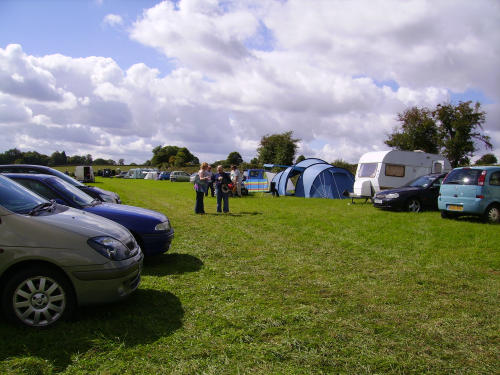
This year will be the third year that I have been a speaker at the Springfield Sanctuary Herb Festival in the Cotswolds. The 'Celebrating Herbs' festival runs from Friday 6th to Sunday 8th September 2013. The other speakers are all amazing - practising medical herbalists and experts in wildcrafting - there are practical workshops and guided herb walks. Camping is available in the field. The programme is here as a printable pdf.

Camping at the Festival.
Photo credit Chris Head

I generally take an historical and folkloric approach to my talks. Last year I spoke on Herbal Fumigants:"Burning, suffumigation and smudge: using smoke to clear the air" based on the idea that many people believe that the practices of burning herbs and smoking were brought to us from the New World with tobacco. So I took a look (with demonstrations) at the Old World uses of non-tobacco smoke, from the incenses and entheogens of the classical period to Bald's Leechbook which tells us "geréc þone man mid þám wyrtum" (smoke that man with the herbs); through the early modern period and into the 20th century.

Demonstrating a mugwort 'smudge' stick.
Photo credit Debs Cook

At the request of a number of people in the audience, as well as some overseas members of Sarah Head's herb apprenticeship programme who were unable to attend, I did promise to make an extended version of my notes available as an e-book, and it is as I start to prepare this year's offering that I'm prompted to get that out before I actually deliver the next one! I do hope some of my herby friends can be persuaded to review it - let me know and I will gift you a copy.

With my 'pirate's chest' of goodies.
Photo credit Debs Cook
This year the title of my talk is "The historical legacy of blessings, curses, and charms in modern western herbalism." I shall be bringing along my wooden box of goodies with loads of things to demonstrate again, (last year's audience called it my pirate's chest!) I think that interacting with the herbs is so valuable to supplement booklearning - it's one of the main reasons why people choose to attend festivals and join groups.

Sarah Head runs Springfield Sanctuary herbal apprenticeships and I am proud to number myself amongst her alumni. Her blog 'Tales of a Kitchen Herbwife' is here.


Springfield Sanctuary is part of Wynyards Farm, a small arable farm in the Cotswolds belonging to Sarah Head's parents, Pryce and Marjorie Watkins.

Debs Cook's Herbaholic website 'Herbal Haven' is here.

Tuesday, May 28, 2013

So you've been accused of witchcraft...?

Herewith for your delectation, a flow chart that sets out your options should you be accused of witchcraft, taken from the Summer 2012 edition is Lapham's Quarterly magazine.

Just on a point of interest though, Malleus Malificarum (Hammer of the Witches) is a treatise on the prosecution of witches, written in 1486 by Heinrich Kramer, a German Catholic clergyman. Here
in England we hanged our witches, we didn't burn them... the Scots did though... You can't say I never post anything useful!